Quantity Surveying & Approximate Cost Guide Module 3: Practical Quantity Surveying for Structural and Finishing Works
Dec 1, 2025
In the previous modules, we covered theory: we learned core terminology in Module 1 and the techniques for reading project documents in Module 2. Now it is time to get hands-on and see how we actually measure and quantify the elements of a building from foundation to roof. This module is the most practical and intensive part of the series. We will walk through how to quantify the main work groups that make up a building step by step. Every item that contributes to the cost of the project is calculated at this stage.
Structural Work Quantity Surveying: Measuring the Building Skeleton
Structural work refers to the main body and load-bearing components of a building. Quantities for these elements are taken from structural drawings.
1. Excavation and Earthworks
Excavation is the first operation to prepare the site for construction.
- How it’s calculated: Use the foundation layout and boundaries in the site plan.
- Basic formula:
Excavation Volume = Area (m²) × Depth (m) - Notes: Slopes and backfill affect total volume.
2. Lean Concrete and Foundation Concrete
- Lean Concrete: A low-strength concrete poured before reinforcement to separate soil and structure.
Calculation: Base area × thickness = volume (m³) - Foundation Concrete: Main reinforced concrete that carries building loads.
Calculation: Foundation area from structural plan × height = volume (m³)
3. Formwork Quantity
Formwork is the temporary structure that shapes poured concrete. Quantities are expressed in surface area (m²) of surfaces in contact with concrete.
Examples of formwork calculations:
- Foundation formwork: perimeter × height
- Column formwork: perimeter × height × count
- Beam formwork: (side surfaces × 2 + bottom surface) × length × count
- Slab formwork: net slab surface area
4. Concrete Quantity by Class
After formwork, actual concrete volume is calculated.
- Calculation: cross-section area × length (or height)
- Why class matters: Each element is specified with a concrete strength class in structural drawings, and quantities should be separated by class.
5. Reinforcement Quantity
Reinforcement (steel) is one of the most detailed and error-prone parts of structural quantity work. Quantities are calculated by weight (kg or tons).
- Process: For each reinforcement type (straight bars, bends, stirrups), use diameter, count, length, and unit weight to compute total weight.
This is where automation tools (like Approx) can greatly reduce errors and speed up the process.
Finishing Work Quantity Surveying: Reducing Entry Complexity
After structural work is completed, finishing work begins. These elements are generally measured from architectural drawings.
1. Wall Quantities (Brick, Block, etc.)
- Calculation: surface area (m²) = length × height.
- Deductions: Openings such as doors and windows must be subtracted when they exceed specified limits.
2. Plaster, Screed, and Painting Quantities
- Plaster quantities (m²): Usually calculated based on wall surface areas, minus openings.
- Screed quantities (m²): Net floor area of the space.
- Floor and wall finishes (m²): Measured using room lists and surface coverage.
Manual Quantity Challenges & Approx Solution
Traditional manual quantity calculation (for example in spreadsheets) requires repetitive steps:
- Calculate wall area
- Calculate window area
- Calculate door area
- Compute net painted wall area = (wall area − window area − door area)
This must be repeated for each room and floor — a tedious, error-prone process.
How Approx Simplifies This
- Room in 3 Rows: Only three inputs are needed to calculate a room’s quantities: room area, perimeter, and ceiling height.
- Smart Formula Library: Define formulas such as:
(Perimeter × Ceiling Height) − Window Area − Door Area
Then assign these formulas to the relevant items (e.g., plaster, paint). - One-Click Calculation: Once inputs are entered, quantities are automatically and accurately computed.
- Copy & Replicate: Instead of recalculating, you can duplicate quantities for similar floors and adjust only the differences.
With this approach, weeks of manual work can be reduced to hours, and results are more reliable.
Door and Window Quantities
- Count: Used for ordering and fabrication (e.g., 12 units of door type D-01).
- Area (m²): Used for deductions in wall and plaster measurements (e.g., door opening = 1.89 m²).
Mechanical and Electrical Quantities (Summary)
- Length-based: Pipes, cables, ducts (measured in meters).
- Count-based: Fixtures and devices (valves, sockets, lights).
Conclusion: What Do We Have Now?
After completing Module 3, we have a large and detailed quantity list, for example:
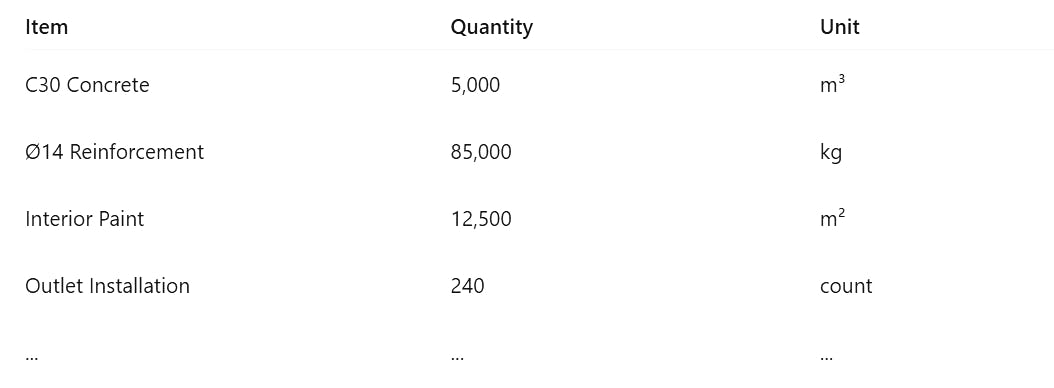
Now we know how much of each work item there is. Next, we must learn what it costs. That brings us to Module 4: converting quantities into money through unit prices and pricing analysis.